
WP 3: Security Management & Optimal Operation
Motivation
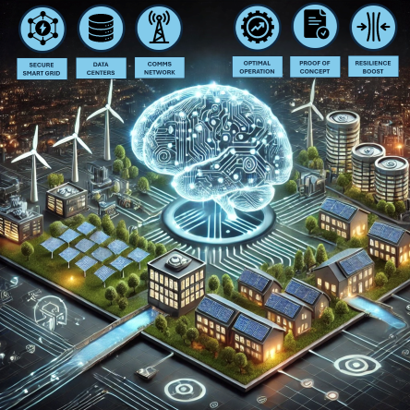
- The increasing penetration of variable renewable generation introduces operational complexity at both transmission and distribution levels, requiring advanced control and optimization strategies.
- Effective coordination of energy resources across buildings, neighbourhoods, and grids is essential to enhance flexibility, stability, and cost-efficiency.
Objectives
- Develop learning-based distributed control algorithms to transform buildings and neighbourhoods into intelligent energy hubs, maximizing clean energy integration and efficiency.
- Design scalable optimization frameworks to enhance SES flexibility, fault tolerance, and resilience while addressing uncertainties and dynamic security constraints.
- Implement and experimentally validate the proposed control strategies using real-life scenarios, industrial data, and testbeds for practical deployment.
Doctoral Candidates Involved in the WP
Personal background
Electrical Engineering M.Sc. Specialized in Automatic Control
Research project
Predictive Hierarchical Control for Integrated Electric-Hydrogen Systems
Objectives
Development of a predictive hierarchical control framework tailored to integrated electric–hydrogen systems.
Expected outcomes
Model architecture explicitly accounting for the multi-time-scale nature of electric–hydrogen systems, leveraging forecasts of both electrical and hydrogen demands, and systematically coordinates conversion, storage, and network operation within a unified optimization-based control scheme.
Main affiliation
Supervisor team
Johannes Schiffer, Alessandra Parisio, Dr. Qureshi (VITO)
Personal motivation
Academic curiosity, the green energy transition

Personal background
Master Integrated Degree:
- Electrical and Computer Engineer (National Technical University of Athens)
- Direction: Energy Systems and Decision making
- Thesis: Optimal operation of smart grids and energy communities at the distribution level
Experience:
- Research Assistant (SPS-LAB)
- Designed frequency reserve requirements for low-inertia power systems.
- Drafted technical requirements for integrating energy storage systems into the distribution and transmission power systems.
Research project
Optimal operation of electric vehicles and heat pumps in Active Distribution Grids
Objective
As part of the Dependable Smart Energy Systems (DENSE) Horizon Europe Program, my doctoral research aims to address the challenges arising from the large-scale integration of Electric Vehicles (EVs) and Heat Pumps (HPs). The main goal is to analyze both the static and dynamic technical constraints of the power system to avoid costly infrastructure upgrades, minimize operational costs, and reduce CO₂ emissions. Special emphasis will be placed on developing methodologies and algorithms to quantify flexibility services provided by the active participation of EVs and HPs, while ensuring compliance with network constraints.
Expected outcomes
In the first phase, we will conduct a comprehensive modeling review and implementation of representative low- and medium-voltage distribution grids, including detailed models for EV operation, building thermodynamics, and HP operation. Penetration studies will assess the technical limits of existing network infrastructure.
The second phase will focus on developing co-optimization algorithms that integrate EVs, HPs, and Renewable Energy Sources (RES) into multi-time-scale scheduling and operational frameworks, enabling aggregated flexibility services and improved distribution–transmission coordination.
In the final phase, the proposed algorithms will be validated through rolling horizon simulations and Hardware-in-the-Loop (HIL) implementations, enhancing their feasibility, scalability, and operational robustness in realistic power system environments.
Main affiliation
Supervisor team
Personal motivation
Passionate about advancing the energy transition by enhancing smart grid technologies and enabling active participation of distributed energy resources like EVs and heat pumps. Committed to bridging the gap between research and real-world applications for a sustainable energy future.

Personal background
Electrical Engineering Background:
- Lebanese American University
- National Institute of Applied Sciences (INSA) Strasbourg
Previous Work:
- Faulted Power Systems
- Design & Operation of Smart Grids
- Renewable Energy
- Electrical Energy Storage Systems
Research project
Advanced Control for Highly Energy-Efficient Buildings and Neighbourhoods
Objectives
The project aims to develop a real-time, scalable control framework that transforms buildings and neighbourhoods into flexible energy assets supporting efficient grid operation. The main objectives are:
- Develop an integrated, physics-informed and data-driven modelling framework for multi-energy neighbourhoods, capturing electrical, thermal, and possibly gas networks together with building dynamics, geographical location, and network connectivity.
- Formulate and validate a scalable Optimal Power Flow (OPF) approach for unbalanced three-phase distribution networks and extend it to include thermal dynamics to enable coordinated multi-energy operation at neighbourhood scale.
- Design a learning-enhanced predictive control strategy (MPC combined with data-driven methods) capable of managing demand-side flexibility, storage, and uncertainty arising from renewable generation, inflexible loads, and consumer behaviour.
- Implement a real-time RTDS–MATLAB co-simulation environment to validate the developed models and control algorithms under realistic grid conditions, enabling progression towards hardware-in-the-loop capability.
Expected Outcomes
The project will deliver:
- A unified multi-energy modelling and control framework that accurately represents buildings, neighbourhoods, and their interactions with distribution networks.
- A scalable OPF-MPC solution that enhances flexibility provision, supports secure and cost-effective grid operation, and can operate in real time under high renewable penetration.
- A learning-based distributed control approach that transforms buildings into positive-energy, flexibility-providing assets, supporting both transmission and distribution system requirements.
- A real-time co-simulation platform enabling rigorous, hardware-relevant validation of control strategies, paving the way for deployment in future smart neighbourhoods and net-zero energy districts.
Main affiliation
Supervisor team
Personal motivation
- Thirst for knowledge to explore advanced optimization techniques for multi-energy systems
- Career aspirations to become a leading expert in power systems optimization
- Real-world impact by applying algorithms and models for more reliable energy systems
Personal background
I received my M.Sc. in Power System Engineering from the University of Tehran. My research has focused on enhancing the performance of energy systems through optimal design, planning, and operational control, particularly in the presence of uncertainties.
Research project
Stable and scalable control algorithms for managing energy flexibility in thermal networks.
Main affiliation
Supervisor team
Personal motivation
As part of the DENSE Doctoral Network, my research focuses on developing scalable control algorithms for managing energy flexibility in district heating and cooling (DHC) networks. The increasing number of flexible assets, such as controllable buildings, poses a challenge for existing control methods. This project aims to design an advanced control architecture that ensures scalability and real-time decision-making in large-scale DHC systems.